 Truth
Truth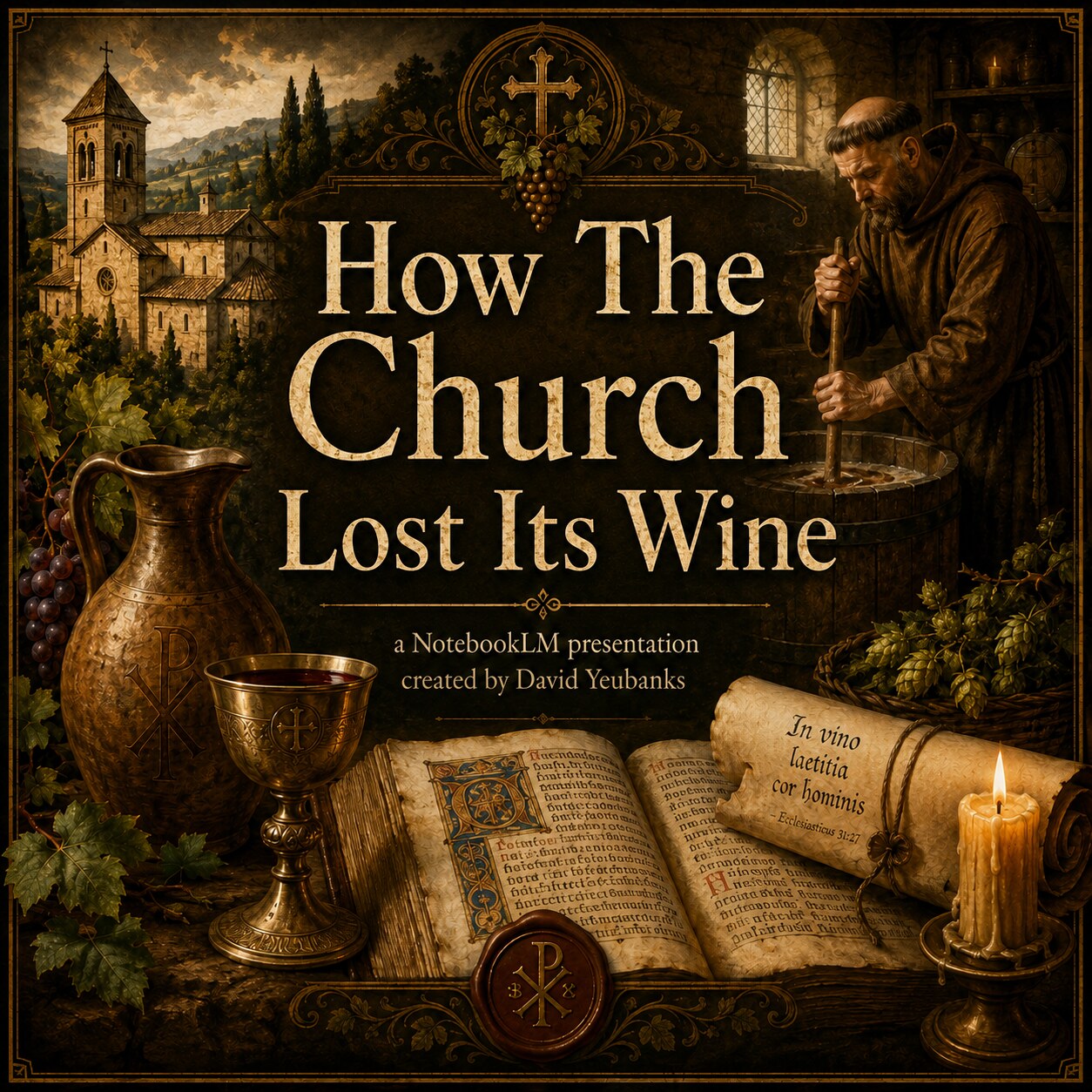
An Audio Overview
How the Church Lost Its Wine
“In vino laetitia cor hominis” Wine gladdens the heart of man · Ecclesiasticus 31:27
A journey through the surprisingly rich and positive history of wine in Scripture and the life of the Church.
From the vineyards of the early biblical world and the tables of the New Testament era, through the great abbeys of the Middle Ages, and down to the present day — this overview traces how a gift God gave for the gladness of man came to be viewed with such suspicion, and how a well-meaning but heavy-handed legalism gradually reshaped the way the Church came to see the fruit of the vine.
▶ Read the Transcript
A conversational overview between two hosts. Auto-generated; lightly cleaned.
God made yeast as well as dough and loves fermentation just as dearly as he loves vegetation.
When you really stop and think about the theology behind that, it's a remarkably bold claim about the physical world.
It really is. And that was Ralph Waldo Emerson, by the way.
Right.
I wanted to start right there because it just perfectly shatters the glass on what we are doing in today's deep dive.
Oh, absolutely.
Because if you are listening to this right now, I really want you to just mentally pack away whatever preconceived notions you might have grown up with.
Yeah, leave them at the door.
Exactly. Maybe you were raised in a very strict religious environment that painted any form of alcohol as the ultimate moral failure.
Which is super common.
Very common. Or on the flip side, maybe your entire perspective comes from secular pop culture. The kind that paints historical believers as these entirely joyless, prudish people who are just terrified of a good time.
Right. The classic buckle-hat Puritan stereotype.
Exactly. So whatever your background is, prepare yourself for some serious historical whiplash today. We are looking at an 1,800-year history of Christianity and alcohol, and the contrast between what we just assume about history and what the actual historical records say is staggering.
Whiplash is honestly the perfect term for it because if we strip away all that modern cultural baggage and look purely at the historical and scriptural record-
Mm-hmm
... we find a reality that is far more complex-
Oh, yeah
... and honestly, far more festive. It's deeply intertwined with the everyday mechanics of life and worship.
So let's bypass all the modern debates for a second and go straight to the foundational text. What do the original ancient documents actually say?
Right.
Because I think if you stopped an average person on the street and asked them, "What was Jesus' first miracle?" Most people would actually know it.
Yeah, they'd say he turned water into wine at a wedding.
Right. But the sheer mind-boggling scale of that event just gets completely glossed over.
It does, and the scale is honestly the key to understanding the whole intent of it.
Tell me about it.
So the event is the wedding at Cana. Now, a 1st-century Jewish wedding wasn't just a four-hour reception with a DJ and a buffet.
Right. Not at all.
It was a multi-day festival. Sometimes it lasted up to an entire week, and the whole community was invited.
Wow, an entire week.
Yeah. So running out of wine wasn't just a minor inconvenience, it was a massive social disgrace for the family hosting it. It meant you completely failed in your basic duty of hospitality.
So the wine runs out, and Jesus steps in. But, and this is the crazy part, he doesn't just quietly snap his fingers and, I don't know, produce a couple of nice vintage bottles for the head table just to save face.
No, not at all.
The text specifically notes there were six stone water pots, and these were normally used for Jewish ritual washing, right?
Exactly.
And each one of those held 20 to 30 gallons.
That's a huge amount.
So if you do the math, he turned somewhere between 120 and 180 gallons of water into top-tier wine.
And keep in mind, this is after the guests had already been drinking heavily for days.
Exactly. That volume is just staggering.
To put it in modern terms, that's roughly 750 to 900 standard bottles of wine.
That is a literal truckload of wine.
It really is. And the cultural context of what happens next is so crucial. The master of the banquet, who is essentially the ancient equivalent of a wedding planner, he tastes it.
Right.
And he actually pulls the groom aside to compliment him. He points out that the standard practice is to bring out the cheap, inferior wine after the guests have had their fill, when their palates are dull.
Right, when they won't notice they're drinking the cheap stuff.
Exactly.
[chuckles]
But he notes that the groom has saved the absolute best for last. So from a purely textual and literary standpoint, this is an undeniable, massive endorsement of wine as a conduit for human celebration.
It really is. I always thought of that story as just a neat little parlor trick to kick off his public ministry, but when you look at the sheer volume, it's a statement.
A huge statement.
And that statement isn't just isolated to the New Testament. If we rewind to the Jewish law, there are explicit logistical instructions for the Israelites that completely upend how we think about ancient religion.
Oh, you're talking about Deuteronomy, right?
Yes, Deuteronomy 14.26. This is a passage outlining what the Israelites are supposed to do with their tithe money when they travel to Jerusalem for the annual festivals.
The wording there is absolutely fascinating.
It really is.
It commands them to take that money and spend it on whatever their soul desires.
Like a blank check for a festival.
Basically. And the text doesn't even leave it vague. It provides very specific examples of what to buy. It lists oxen, sheep, wine, or strong drink.
Strong drink.
Yes. It literally instructs them to purchase these things so they can feast and rejoice before God.
Strong drink. That is definitely not a phrase you hear in a lot of Sunday school lessons today.
No, definitely not.
And it tells them to do this as an act of worship.
Precisely. The underlying theology of the ancient Near East was that the physical world was inherently good because it was created by God.
Okay, that makes sense.
So alcohol wasn't merely tolerated with a sigh and a wagging finger. It was interwoven into the very fabric of gratitude.
Right. It was celebrated.
You see this repeatedly. Like Psalm 104.15 explicitly praises God for bringing food from the earth, and it specifically mentions giving wine to cheer us up, or, depending on the translation you read, to make the heart glad.
Yeah, I've heard that one.
And going even further, in Numbers 28.7 Alcohol is actually commanded to be poured out on the altar as a drink offering to God.
So it's structurally embedded in the religious system.
Exactly.
Which makes a lot of sense when you look at how Jesus himself was treated by the religious elite of his own day.
Oh, this is a great point.
Right. Because in Matthew 11, the Pharisees and the religious leaders are disparaging him, and they hurl this specific insult. They call him a glutton and a drunkard. Now, they weren't saying that because it was true that he was an alcoholic, but they were weaponizing his normal social habits against him.
They were contrasting him directly with John the Baptist.
Right. John was completely different.
Yeah. John lived in the wilderness. He wore camel's hair, ate locusts, and practiced this very strict asceticism, meaning he fasted constantly and drank no wine at all.
He was the picture of rigid, austere denial.
Exactly. Jesus, on the other hand, was constantly attending feasts, dining with tax collectors, and drinking wine with everyday, ordinary people.
He was part of the community.
Yeah. And the religious elite, who prized these outward shows of extreme piety, they looked at his joyful participation in normal human life and just tried to smear him for it.
But this creates a massive tension, I think. Because if you read those same foundational texts, they absolutely, universally, and consistently condemn drunkenness.
Oh, absolutely.
There is no gray area there. Drunkenness is described as a path to poverty, destruction, moral collapse. It says wine is a mocker and strong drink is a brawler. So how on earth did the ancient mind reconcile the command to buy strong drink and rejoice with this incredibly strict warning that drunkenness will destroy your life?
Well, they reconciled it through the virtue of temperance.
Okay. Unpack that.
So the ancient view-
Mm-hmm
... held that the misuse of a thing does not negate its proper use.
Oh, that's good.
Right. Like fire can burn your house down, but it also cooks your food and keeps you warm.
Exactly.
So the texts portray alcohol as a powerful gift meant for enjoyment, but one that requires immense personal responsibility and boundary-setting. It's this delicate balance of utilizing the gift without letting the gift enslave you.
That makes complete logical sense. But I have to say, modern interpreters have done some absolute mental gymnastics to avoid that tension entirely.
Oh, the mental gymnastics are Olympic level.
Seriously. If you grew up in certain circles, you were probably taught ways to just explain away all these positive biblical references to wine.
Yep.
So I want to spend a minute busting two of the biggest myths that have been engineered to sanitize this history.
Let's do it.
The first one is the infamous grape juice myth. This is the idea that whenever the Bible speaks positively about wine, it's actually just referring to unfermented, non-alcoholic grape juice.
That argument is incredibly common today, but it completely collapses under even the slightest linguistic, historical, or scientific scrutiny.
Break it down for us.
Let's look at the linguistic side first. On the day of Pentecost, in Acts 2, the apostles are suddenly speaking in various foreign languages, right?
Right.
The skeptical crowd observing this doesn't understand what's happening, so they accuse the apostles of being drunk on new wine.
Which is a very specific accusation.
Exactly. Now, if new wine was simply a cultural term for unfermented grape juice, that accusation of drunkenness makes zero logical sense.
Right. You cannot get intoxicated on a juice box.
You really can't. The mockery only lands if the substance they are referencing actually contains alcohol.
And the historical context of the Jewish Passover dismantles it even further, right?
Oh, totally.
Because during the feast of Passover, the Israelites were strictly commanded to remove all leaven, meaning yeast, from their homes.
Right.
But that rule specifically applied to leaven derived from grain, like you would use in baking bread. Vinous fermentation, which is the fermentation of grapes into wine, was considered perfectly lawful. They actively consumed fermented wine during the Passover meal.
We also have to look at the basic science of antiquity here. The ancient world simply did not have the technology to stop grape juice from fermenting.
They just didn't have the tools.
Grapes naturally have wild yeast growing on their skins. When you crush grapes in a warm Mediterranean climate, that yeast immediately begins consuming the sugars in the juice and converting them into alcohol.
It's automatic.
Unless you have a way to boil the juice and seal it in a vacuum, which they absolutely did not, fermentation is an unstoppable chemical inevitability. So claiming they drank unfermented grape juice all year round is just scientifically impossible.
Which perfectly tees up the second major myth, and this is one I hear constantly.
Let me guess. The safe water argument.
Yes, the safe water argument.
Mm.
People love to say, "Well, of course they drank wine back then. The water supply was stagnant. It was full of dysentery, completely unsafe to drink. They had to drink alcohol just to survive."
It sounds so plausible to a modern ear, doesn't it?
It really does.
But it is entirely a modern invention. It simply isn't supported by the historical or biblical record. The ancient texts contain literally hundreds of references to fresh, clean drinking water.
Right, like all over the place.
You have thriving communities built around natural springs, deep wells, freshwater lakes. You have Moses drawing water from a rock to hydrate an entire nation in the desert.
Yeah.
You have the military account of Gideon's army drinking directly from a flowing stream. You even have Jesus himself sitting down at a well and asking a Samaritan woman to draw him a drink of fresh water.
Plus, water was heavily used in the cleansing rituals of the temple.
Exactly.
You can't perform strict religious purification rites in contaminated sludge. The water was fine.
It was fine.
Mm.
Now, to be fair to history, were there stagnant pools or specific cities with poor sanitation? Of course.
Sure.
But the overarching idea that the entire ancient Mediterranean lacked safe drinking water, forcing literally everyone to rely on wine for hydration-
Mm
... is a total myth.
Okay, but that brings up a really valid historical question, then. If the water was perfectly safe to drink- Why did ancient people so frequently mix water with their wine?
Ah, that's the real question.
Because that's a documented practice. The Greeks did it, the Romans did it, the ancient Jews did it. If it wasn't to kill the bacteria in the water, what was the mechanism there?
The real reason they mixed water into their wine is fascinating, and it actually points back to their desire to consume alcohol without crossing the line into that condemned state of drunkenness.
Oh, I see.
It was all about diluting the alcohol content. In the ancient world, social gatherings, symposiums, and feasts lasted for hours, sometimes all night.
Right. They weren't in a rush.
It was customary to drink large quantities. We're talking sometimes four, five, or more large cups over the course of an evening.
Right. And if you drink four large cups of uncut, heavy wine-
Yeah
... you aren't just gladdening your heart, you are passed out under the table.
Precisely. So by cutting the wine with two or three parts water, they significantly lower the alcohol by volume.
It was a pacing mechanism.
Exactly. This allowed them to drink constantly throughout a long evening, enjoying a prolonged euphoric buzz without becoming completely incapacitated or losing their self-control.
Let me throw an analogy at you.
Go for it.
Claiming that ancient people only drank alcohol because the water was unsafe feels a lot like modern historical revisionism claiming that cowboys in the American Wild West only drank whiskey in the saloon because milk hadn't been pasteurized yet.
That is hilarious and so true.
It's completely absurd. It misses the basic universal human reality. People drank the whiskey, and the ancient people drank the wine because they enjoyed the intoxicating effects. They liked the feeling.
That is a perfect way to frame it. It strips away this retroactive moralizing we constantly try to impose on history.
We really do try to clean it up.
We want historical figures to fit our modern behavioral standards, so we just invent logistical excuses for them.
So if the foundational texts are explicitly pro-enjoyment and the ancient culture was scientifically incapable of stopping fermentation and entirely comfortable with a prolonged buzz, how did a narrative of absolute prohibition ever gain traction?
That's the million-dollar question.
To understand that, I think we have to travel out of the ancient Near East and move forward into the early Church in the Middle Ages because, spoiler alert, for the first 1,800 years of Christian history, the Church didn't just tolerate alcohol.
No, they went all in.
They perfected it.
They absolutely did. But before we get to the massive commercialization in the Middle Ages, we really should look at the early Church Fathers.
The theologians in the first few centuries after Christ.
Yes. Their baseline stance was unwavering.
Mm.
Moderation, not prohibition.
Right. You have these towering intellectual figures like Clement of Rome, John of Egypt, and Gregory of Nyssa.
Huge names.
These weren't fringe voices, right? These were the guys shaping early Christian thought, and they all wrote extensively acknowledging that wine is a gift that gladdens the heart while simultaneously warning their congregations about the destructive, chaotic nature of drunkenness.
We also have some really fascinating practical documents from this era.
Like what?
Take the Didache, for example.
Mm.
It is one of the earliest known manuals of Christian practice. It was essentially a handbook for how early communities should operate.
Okay.
It explicitly instructed early believers to set aside a portion of their wine yield to support traveling prophets.
Wow.
And if no prophets were passing through town, they were instructed to give that wine directly to the poor.
That blows my mind. Today, we'd organize a canned food drive. Back then, they were donating casks of wine as a form of charitable welfare.
Exactly. It was viewed as a valuable commodity, a staple calorie source, and a blessing to be shared.
But if we're talking about early Church Fathers, we have to talk about St. John Chrysostom.
Oh, Chrysostom.
[chuckles]
He is quite the character.
He is my absolute favorite from this era. This guy was a firebrand. He operated in the late 4th century, and he was the ultimate uncompromising advocate for wine.
Uncompromising is a good word for him.
Now, to be clear, he strongly warned against intoxication, but he fiercely defended the drink itself against anyone who tried to label the physical substance as evil.
Right.
He argued that heretics who blame the fruit, the wine itself, rather than the individual person who is abusing it, are immature and foolish.
He was really fighting against the creeping influence of Gnosticism and extreme asceticism.
Right, those philosophies that taught that the physical world and physical pleasure were inherently corrupt.
Exactly, and that only the spiritual realm was pure. Chrysostom saw that as a dangerous heresy, and his methods for dealing with it were, well, incredibly direct.
Very direct.
Oh.
He famously advised his congregation that if they were out in the public square or at a market and they heard someone blaspheming the use of wine, literally someone saying that wine itself was an evil creation, they should step right up and punch that person in the mouth.
It certainly paints a very different picture of 4th-century pastoral care.
You definitely aren't hearing that preached from a modern pulpit. If someone insults a Pinot Noir, strike them down.
Yeah. Try putting that in a church bulletin.
But as intense as that is, it shows how fiercely protective they were of the idea that God's physical creation is good.
Yes, absolutely.
Now, as we move forward into the Middle Ages, this relationship between the Church and alcohol evolves from theological defense into an incredibly systematic, highly organized industry. We have to talk about monastic brewing.
This is truly a pivotal moment, not just in religious history, but in global culinary history.
Right.
During the Middle Ages, the production of ale skyrocketed across Europe.
Mm.
But to understand the monks' impact, you have to understand how brewing worked before they took over.
Set the scene for us.
For centuries, ale was primarily brewed domestically by women using what were essentially large multipurpose stew pots in their kitchens.
So they're making dinner, boiling clothes, and brewing ale all in the same vaguely clean cauldron.
Exactly. The sanitary conditions were, by modern standards, abysmal.
I can only imagine.
Because they didn't understand wild yeast or bacteria, they would often end up with contaminated batches that would make people violently ill. And because of this, these women were sometimes culturally referred to as brew witches.
Wait, hold on. Is that where the cultural concept of a witch's brew actually comes from?
It is entirely tied to that history. The bubbling cauldrons, the unpredictable results, the occasional sickness, it birthed a massive cultural trope.
That is wild.
But then the monasteries step in. The monks bring an unprecedented level of order, record-keeping, and most importantly, cleanliness to the brewing process.
Okay, so they clean it up.
Even though they didn't possess a modern understanding of germ theory, their strict rules regarding the sanitation of vessels, the boiling of the wart, and the isolation of the brewing process, essentially invented commercial sanitary brewing.
So they take this chaotic, sometimes dangerous domestic chore and turn it into an industrial science.
Yes, they did.
And they didn't just do it so they could sit around and drink all day. They produced vast quantities of high-quality commercial ale to raise funds for the church, to build infrastructure, to feed the poor, and to provide a reliably safe, nutritious beverage for the surrounding community.
And we shouldn't underestimate the scale of their own personal consumption either. The monastic records are astonishing.
I've read some of this. It's crazy.
Depending on the specific order and the region, historical records show that monks received daily allotments of up to five liters of beer.
I need you to pause on that for a second. Five liters.
Yes.
That is over a gallon of beer per monk every single day.
It is a massive caloric intake.
How did they function?
Well, you have to remember the context of their lifestyle. During intense fasting seasons, like Lent, they were forbidden from eating solid food, and they were forbidden from drinking wine.
Right.
But they were explicitly allowed to drink beer.
Yes.
They literally refer to it as liquid bread.
Liquid bread.
The heavy, unfiltered ales provided the necessary carbohydrates and calories to keep them alive and working in the fields while they were fasting from solid meals.
That is such a fascinating loophole. Like, I can't eat bread, but I can drink a gallon of liquid bread.
Pretty clever, right? [chuckles]
And the legacy of this monastic dedication to brewing is literally still with us today. If you look at Trappist beers, which are still brewed by monks in abbeys in Europe under incredibly strict historical rules, they are widely considered by modern connoisseurs to be some of the absolute best, most complex beers in the world.
Oh, no question. And the medieval church's integration with alcohol goes even deeper into their actual rituals.
Yeah. Let's talk about some of the weirder stuff from this era.
There are some incredible historical oddities. For instance, there was a 13th century archbishop in Trondheim, Norway, who literally believed in baptizing people with beer instead of water.
Okay, I have to know the mechanism behind that. Why beer? Was the water frozen solid in Norway, or was beer just that culturally dominant?
It was likely a combination of both. In the harsh Scandinavian winters, finding unfrozen running water for a baptism could be logistically difficult.
Right.
Whereas the ale was always flowing.
That is amazing.
But the Pope eventually caught wind of this practice and had to write a formal letter instructing the archbishop to stop, insisting that only water was valid for the sacrament.
Party pooper.
Right. But it shows how deeply ingrained the beverage was in the religious mindset. You also see this across Europe with the tradition of ordination beers.
What were those?
When a new bishop or the head of a church was appointed, a massive special keg of ale was tapped specifically to celebrate their ordination with the community.
So the medieval worldview wasn't just tolerating this, they were overtly celebrating it. What was the underlying philosophy that made them so comfortable with this?
It goes back to the framework beautifully summarized by Thomas Aquinas. The medieval worldview was profoundly centered on the virtue of temperance.
There's that word again.
Yes. For them, the goal of a holy life was not to outlaw or destroy physical pleasure. The goal was to regulate it properly.
Right.
Now, total abstinence did exist, but it was viewed as a highly respected, deeply personal calling for a select few.
Sort of like a special vow.
Exactly. For example, St. Augustine's mother, Monica of Hippo, chose to stop drinking, but her choice was viewed as a specific personal sacrifice, much like a vow of silence. It was never pushed as a universal mandate or a moral requirement for all everyday believers.
Right. If I'm trying to picture this, it's like the monastic brewing system was the medieval equivalent of a modern-day church bake sale or a church coffee shop.
That's a great way to think of it.
Just on a massive industrial scale, churning out gallons of ale and literally shaping global culinary culture in the process.
That is a very apt comparison. They saw absolutely no dividing line between their sacred duty to God and the production of a good fermented beverage for their neighbors.
So this brings up an assumption I think a lot of people would make. If the Catholic monks were the original brewmasters, and Catholic bishops were out there trying to do beer baptisms...
I see where you're going with this.
I would naturally assume that when the Protestant Reformation hit in the 16th century, the reformers would use that as ammunition.
Right. Because they fought about everything else.
Exactly. I'd assume they would look at the wealth the monasteries were generating from beer, declare the whole thing corrupt, try to sober everybody up, and reject alcohol entirely.
It's a very logical assumption to make given how much the reformers wanted to distance themselves from Catholic traditions, but you would be entirely wrong.
Wow.
Far from rejecting the Catholic embrace of brewing, the Protestant reformers, and later the early American settlers, actually doubled down on it.
They leaned in.
They really did.
Let's talk about Martin Luther, the man who kicked off the entire Reformation by nailing his 95 Theses to the church door. His close friends actually nicknamed him the King of Hops.
Luther's relationship with brewing is a fantastic piece of history. His wife, Katharina von Bora, was a former nun who escaped her convent and eventually became a master brewer.
She is an icon.
Truly, she ran a highly successful household brewery producing massive quantities of beer. And Luther wasn't just passively enjoying it. He actively used the proceeds from her commercial beer sales to fund his writings, his travels, and his church projects.
So the Reformation was quite literally fueled by craft beer.
It really was.
And Luther's writings on the subject are just incredibly witty, but they also contain profound theological points. He wrote, "It is better to think of church in the ale house than to think of the ale house in church."
It's a brilliant quote. He was pointing out that true piety is an internal state of the heart, not an external location.
He also said, "Men can go wrong with wine and women. Shall we prohibit and abolish women?"
That's classic Luther.
He was using this biting logic to point out the absolute absurdity of banning a fundamentally good thing just because flawed humans have the capacity to abuse it.
Right. Exactly.
And he was fiercely, fiercely protective of the tradition regarding communion. He absolutely opposed the idea of substituting anything else for wine in the Lord's Supper.
Yeah, he wouldn't budge on that.
He insisted that if you couldn't tolerate wine for some reason, you should just skip the sacrament altogether rather than invent an unbiblical substitute.
And Luther wasn't an outlier in this regard either. John Calvin, another giant of the Reformation, who is often associated with very strict theology, shared this exact perspective.
Really? Calvin?
Yes. Historical records show that the city council in Geneva sometimes literally paid Calvin for his preaching services with massive casks of wine.
That is wild.
Calvin wrote beautifully on the subject, stating that wine was given to humanity owing to what he called God's superabundant liberality. He explicitly noted that it was given not only for necessity but also to make us merry.
God's superabundant liberality. I love that phrasing.
Me too.
Okay, so the heavy-hitting European reformers clearly loved a good drink, but what about when we cross the Atlantic? Let's look at the Puritans.
Oh, the Puritans.
When I say the word Puritan, I guarantee you that everyone listening instantly pictures the uptight, joyless, buckle-hat-wearing legalists from Nathaniel Hawthorne's "The Scarlet Letter."
The modern caricature of the Puritan is honestly one of the most successful historical smears in all of literature.
Really?
Yes. The reality of how the Puritans actually lived is completely different. They were absolutely not opposed to physical pleasure. They drank freely.
Wow, okay.
In fact, if you read the journals of the early settlers on the ships crossing the Atlantic, they complained bitterly, almost to the point of mutiny, when the beer rations ran low.
A ship full of angry, sober Puritans.
Exactly. Furthermore, they highly encouraged physical enjoyment, including sexual intimacy within marriage, viewing it as a profound gift.
It totally shatters the stereotype. I read that in Dorchester, Massachusetts, the early Puritans actually opened a local brewery, much like the medieval monks did.
Yes, they did.
And they explicitly used the profits from the beer sales to clothe and educate needy children in the colony.
It was a community staple.
And Cotton Mather, the infamous Puritan minister, who is usually associated with the grim history of the Salem witch trials, he actually went out in public and officially blessed the opening of a local ale house.
Which seamlessly transitions into the broader American context. By the time of the Founding Fathers, this highly favorable celebratory view of alcohol was thoroughly baked into the DNA of the culture.
Oh, yeah. Franklin loved a good quote on this.
You have Benjamin Franklin famously, and very accurately to the spirit of the time, stating, "Beer is living proof that God loves us and wants to see us happy."
And here's a piece of historical trivia that I think really drives the point home. Bourbon whiskey, the absolute iconic American spirit, was actually invented by a Baptist minister.
What's truly fascinating here isn't just the fact that they drank, it's the robust theology behind why they drank.
Right, let's unpack that.
There is a concept that modern theologian Jerome Burns refers to as redeeming leisure.
Redeeming leisure?
Yes. The reformers and the early American settlers viewed physical pleasure not as a distraction from spiritual things, but as a lens through which to see God's goodness more clearly.
Let's unpack that mechanism, because in a lot of modern circles, there is this creeping asceticism.
Oh, definitely.
It's the idea that enjoying life or seeking pleasure damages your soul. If you have a hobby or if you sit on the porch with a beer, you have to have spiritual justification for it.
Right, like, "I'm only drinking this ale so I can evangelize the guy sitting next to me."
Exactly.
The reformers would have viewed that modern mindset as deeply unbiblical. Their mindset was that the more clearly you gaze upon the Creator, the brighter, richer, and more enjoyable the physical creation should become.
You didn't need an excuse.
Exactly. You didn't need an evangelistic excuse to enjoy a beer or watch a sunset. You drank the beer because it tasted incredible, because the euphoric feeling made you happy, and because it provided an opportunity to thank God for the experience of being alive.
It's a very grounded way to live.
Christ's work was viewed as restoring human life and all its richness, not stripping life and joy away from humanity.
To put it in today's terms, Martin Luther sitting around a wooden table debating heavy theology in a pub with a massive stein of beer in his hand is a lot like modern podcasters recording a show in a local bar.
That's exactly it.
It completely blurs that artificial manufactured line we've drawn between sacred spiritual spaces on Sunday morning and the secular everyday life of Monday night.
It was a deeply holistic view of life. There was no division between the spiritual and the physical.
So this is the crux of the entire deep dive today.
Okay, lay it out.
If the heavy hitters of early theology, the medieval monks, the Protestant reformers, the early American settlers, and the Founding Fathers were all happily raising a glass
Mm-hmm.
Where exactly did the aggressive alcohol is inherently a sin narrative come from?
Right.
Because we've just established that it certainly didn't exist for the first 1,800 years of the church.
It didn't exist. Which brings us to the 19th century.
The pivot.
Yes. This era represents a massive, unprecedented pivot in Christian history. An 1,800 year streak of brewing, feasting, and merrymaking comes to a screeching, abrupt halt.
And why?
It happens due to a perfect storm of technological innovation, social movements, and very specific denominational shifts.
And the primary disruptors of this 1,800 year tradition were the Methodists.
Specifically, the founder of the Methodist Church, John Wesley.
Right.
He was really one of the very first major mainstream church leaders to vehemently publicly oppose strong liquors. He used incredibly harsh language, calling the makers of alcohol poisoners and murderers accursed by God.
Which is fascinating because history is always full of weird contradictions.
Always.
There's another historical account claiming Wesley actually wanted people to drink alcohol instead of tea for health reasons.
Seriously?
Yeah. And we know for a fact that his brother, Charles Wesley, who wrote hundreds of famous hymns that churches still sing today, certainly enjoyed his ale.
That is quite the contradiction.
But John's fierce anti-liquor rhetoric is what stuck, and his rapidly growing denomination became the cultural rallying point against alcohol.
But here's the critical mechanism to understand.
Yeah.
Ideology and rhetoric alone were not enough to change an 1,800 year entrenched global practice.
Right. You need more than a sermon.
Exactly. They needed a catalyst. They needed technology. Enter a man named Thomas Bramwell Welch.
The grape juice guy.
The grape juice guy, exactly. Thomas Welch was a Methodist deacon. He was intimately aware of the anti-alcohol theology brewing in his denomination.
Okay.
He was also aware of Louis Pasteur's newly discovered, groundbreaking method of pasteurization. So Welch took Pasteur's scientific method and applied it directly to grape juice.
Okay, let's explain the mechanism of what pasteurization actually does in this context, because it's the linchpin of the whole shift.
Go for it.
Pasteurization involves heating a liquid to a very specific temperature for a set amount of time. It's hot enough to kill the wild yeast and bacteria naturally living on the grape skins, but not so hot that it boils the juice and ruins the flavor. It's a delicate balance.
Exactly. And by doing this, Welch effectively sterilized the juice. For the first time in human history, someone successfully and reliably prevented grape juice from fermenting naturally.
It is a monumental technological breakthrough.
Massive.
And it is crucial to note that Welch didn't invent this pasteurized grape juice to pack in kids' lunchboxes or sell at the grocery store.
Oh, wait, really?
No. He created it specifically to replace communion wine.
Wow.
At first, he sold it almost exclusively to churches. He fundamentally altered a millennia old, globally practiced sacrament using a brand-new scientific invention.
This technological breakthrough provided the exact ammunition the rising temperance movement needed.
They jumped right on it.
Because up until this point, you couldn't ban alcohol entirely without essentially outlawing the central sacrament of the Christian faith. But now they had a workaround.
Exactly.
As the 19th century progressed, organizations like the Women's Christian Temperance Union, or WCTU, formed, and this is where the history gets deeply intertwined with the social realities of the era. We really have to paint a picture of 19th century saloon culture to understand their motivation.
It wasn't just about being prudish.
Not at all. The temperance movement didn't just emerge in a vacuum. This was the era of the Industrial Revolution.
Mm-hmm.
Men were working grueling factory jobs, and they would often take their entire weekly paycheck straight to the saloon, drinking it away before they ever made it home.
And the legal reality for women at that time was incredibly bleak.
Very bleak.
They had very little legal recourse, they didn't have the right to vote, and they often had no property rights. If a husband drank away the family income or became violently abusive, the woman and her children were utterly trapped in destitute poverty.
They were completely stuck.
So for the WCTU, the fight for women's suffrage and the fight against the saloon became the exact same fight. It was a matter of basic economic and physical survival.
Exactly. It was a social justice movement aimed at protecting vulnerable families from the very real ravages of industrial saloon culture.
Right.
Eventually, this momentum led to the formation of the Anti-Saloon League, which became the single most powerful political lobbying force in the United States.
They were massive.
They were backed heavily, both financially and culturally, by Methodists, Baptists, and other Protestant denominations.
While the older liturgical churches, like the Catholics, Episcopalians, and Lutherans, mostly disapproved of this radical shift, the political momentum was completely unstoppable.
It just bulldozed them.
The intense lobbying culminated in the passage of the 18th Amendment to the US Constitution, the absolute total prohibition of the production, transport, and sale of alcohol. The moralists won their war.
But the way they won the theological war is perhaps the most astonishing part of this history.
Oh, this part drives me crazy.
Right. Because once Welch's pasteurized grape juice became widely accepted as the standard for communion in these Protestant churches, a massive intellectual leap occurred.
It's unbelievable.
Suddenly, church leaders began actively teaching from the pulpit that the wine mentioned in the Bible, the wine Jesus made at Cana, the wine commanded in Deuteronomy, was actually unfermented grape juice all along.
That is just straight up retconning.
Yes.
It is intellectual dishonesty on a massive scale. As we established earlier, from a purely scientific standpoint, pasteurization was impossible in antiquity. The wild yeast on the grape skins guarantees fermentation in a warm climate.
It's science.
Furthermore, if the ancient wine was just unfermented Welch's juice, why would the early church fathers like Chrysostom need to constantly aggressively warn people against intoxication?
It creates a completely incoherent reading of history and scripture.
It's absurd. It's like rewriting history to say that George Washington crossed the Delaware River in a Honda Civic.
That is a perfect image.
The technology simply did not exist. I look at Thomas Welch's invention of pasteurized grape juice sort of like the invention of the electric guitar in music.
Oh, I like that comparison.
Think about it It was a sudden, massive technological breakthrough that permanently changed the cultural landscape. Once the electric guitar arrived, the sound and trajectory of popular music was never the same.
True.
Once Welch figured out how to kill the yeast on a grape skin, the American church's relationship with communion and alcohol in general was never the same.
That analogy works perfectly, and this rapid shift illustrates a powerful sociological concept known as the dictatorship of the small minority.
Tell me about that.
This theory shows how an inflexible, highly motivated, and extremely vocal minority can entirely change the behavior of the flexible majority.
Interesting.
The older churches that enjoyed wine didn't care enough to fight a massive political war over it, so they just acquiesced. A relatively new strict interpretation swallowed 1,800 years of established global tradition in just a few short decades.
So the small minority wins. The temperance movement gets prohibition written into the very Constitution of the United States.
They got what they wanted.
The American Evangelical Church entirely embraces grape juice and abandons its brewing roots. But we have to look at the results. Did legislating morality actually work? Did removing the substance make society safer and holier?
The historical data provides a resounding no.
Yeah. Not even close.
The psychological, societal, and physical results backfired spectacularly.
Let's look at the immediate fallout of the 18th Amendment. At first, there was a dip. Alcohol consumption dropped to about 30% of its pre-prohibition levels.
Right.
The temperance folks were thrilled, thinking they had cured society, but human nature, combined with the allure of a taboo, kicked in. Over the next several years, consumption spiked right back up to 60% or 70%.
But the crucial difference was that this massive consumption was now entirely unregulated, untaxed, and driven underground.
It became dangerous.
Very dangerous. The church and the state may have felt morally vindicated on paper, but in reality, prohibition fueled the rapid rise of violent organized crime.
Like Al Capone.
Exactly. Massive, brutal syndicates run by figures like Al Capone, who built empires on bootlegging. Furthermore, statistical studies from the era show that the prohibition actually correlated with an increase in mental health issues and violent crime rates across the board. The cure proved to be vastly more damaging than the disease.
But the damage didn't magically end when prohibition was finally repealed. We are still dealing with the cultural and psychological fallout today, specifically with America's modern binge drinking problem.
It is a massive problem.
The statistics are incredibly rough. Studies show that between 1993 and 2001 alone, 18 to 20-year-olds experienced a massive 56% increase in binge drinking. In the US today, almost half of all drinking occasions result in intoxication.
This raises a fascinating and honestly vital question of cultural comparison.
Yeah.
If we look at European countries like France and Italy, places where the historical Christian view of moderation was never interrupted by a massive prohibition movement, the data is vastly different.
How so?
In those countries, alcohol is introduced gradually, openly, and responsibly within the family unit by parents.
Right. It's not a secret. You are 15 years old, having a small glass of wine with Sunday dinner alongside your mom and dad.
Precisely. It is modeled behavior.
Yeah.
And as a result, in many Southern European countries, only one in 10 drinking occasions results in intoxication.
Wow. Compared to one in two here.
Exactly. By making alcohol an illicit, hidden taboo until the age of 21, the US removed the opportunity for responsible modeled introduction.
There is a brilliant, counterintuitive sociological paradox that explains exactly why this happened. It's called the no speed limit safety paradox.
I love this concept. It is a fascinating case study in human psychology and legislation.
It really is.
Yeah.
So for a period of time, the state of Montana had no daytime speed limits on its rural highways. The law essentially just said you should drive at a speed that is reasonable and prudent.
Which leaves it up to the driver.
Exactly. You had to use your own judgment. And statistically, that era of zero mandated speed limits was actually the safest period in the history of Montana's interstate highway system.
That's so crazy to think about.
But then the federal government stepped in, threatened to pull highway funding, and forced Montana to implement strict low speed limits with heavy police enforcement. What happened? Fatal accidents literally doubled.
When you apply the mechanics of this paradox to the church and alcohol, the parallels are incredibly striking.
Yes, they are.
For 1,800 years, the church operated without a strict speed limit on alcohol. They didn't ban it. Instead, they preached internal personal responsibility, moderation, and temperance.
They asked believers to self-regulate.
Exactly. But once the 19th century church stepped in to aggressively legislate morality from the outside, impose strict prohibition, and label the substance itself as evil, the internal mechanism of temperance broke down.
It just snapped.
Alcohol abuse, hidden consumption, and dangerous binge drinking skyrocketed.
It's the psychological rebound effect. You see this exact same mechanism in extreme dieting.
Oh, for sure.
If you restrict a food completely, lock it away in the pantry, and mentally label it as evil or sinful, you never learn how to consume it in a healthy, regulated way.
No, you don't.
You never learn portion control. You just end up binging it in secret at 2:00 a.m. when no one is looking. By making alcohol the ultimate religious and cultural taboo, the church inadvertently made it irresistibly enticing to generations of teenagers.
And beyond the physical danger of binge drinking, there is a profound, lingering theological and psychological damage Caused by this inherited asceticism.
Right. Going back to redeeming leisure.
Yes. Today, many well-meaning believers carry a heavy, entirely unbiblical guilt for simply enjoying their lives. They feel that every action, every hobby, every moment of relaxation must have a purely spiritual justification.
It's exhausting.
They have lost the ability to simply sit on the porch, enjoy the goodness of a beautifully crafted beverage, and be grateful without feeling a creeping sense of shame.
So looking at this massive historical whiplash, from monks brewing a gallon a day to survive Lent, to the Anti-Saloon League changing the US Constitution, where does this leave the modern individual?
It's tough.
If you are listening to this on your commute or while walking the dog, how do you balance personal freedom with historical tradition without repeating the mistakes of the past?
Well, if we synthesize the historical and biblical stance we've uncovered today, it really comes down to two absolute truths held in tension.
Okay.
First, the physical world, including alcohol, is consistently presented as a gift of creation to be enjoyed with gratitude. Second, the abuse of that gift, drunkenness, is universally condemned as chaotic and destructive.
And we absolutely have to acknowledge the dark side of this reality.
Yes, we do.
We all know the deep pain, the shattered families, the domestic abuse, and the terrible suffocating grip of addiction that alcohol can cause when it is abused.
It's a very real danger.
Moderation is vital. Respecting the conscience and the struggles of others is vital. If someone you know struggles with addiction, you don't tempt them, you don't pressure them, and you certainly don't flaunt your freedom in their face. That is just basic human empathy.
Absolutely.
But at the same time, we have to look honestly at verses like Titus 1.11, which explicitly states, "To the pure, all things are pure." You shouldn't have to carry manufactured religious guilt for enjoying a glass of wine with your dinner.
Navigating that tension requires a profound level of maturity. It asks the individual to self-regulate based on their own conscience, their own biology, and the well-being of their neighbor, rather than relying on a blanket external prohibition to enforce morality from the outside.
I can't help but picture what it would look like if the modern church actually reclaimed its deep historical roots.
Oh, that'd be something.
Imagine if, instead of inflaming culture wars, organizing boycotts, and shouting at each other over the Internet, churches built local breweries and ale houses right next to their sanctuaries.
They already do it with modern coffee shops.
Exactly. Imagine a church using the proceeds from a phenomenal craft beer to fund incredible generosity, to pay off medical debt for the community, to feed the poor, doing exactly what the medieval monks and the early American Puritans did.
It fundamentally changes the cultural narrative. If parents modeled responsible boundaries at home over dinner, the allure of the college party till you puke culture would seem ridiculous and juvenile to their kids.
It completely flips the script.
It removes the dark allure of the taboo and replaces it with the ancient virtue of temperance.
Exactly. A beer with Mom and Dad wouldn't be a secret sin. It would be an education in boundaries.
As we wrap up this exploration, there's a fascinating thread we've pulled today that extends far beyond just the topic of alcohol.
There is, and I'm going to leave you, the listener, with a thought to mull over long after this deep dive ends. We saw today how a dramatic, massive shift in how millions of people view morality, scripture, and daily life was largely made possible by a single 19th century technological invention.
Pasteurization.
Yes. Louis Pasteur figured out the mechanism of pasteurization. Thomas Welch used that tech to make unfermented grape juice, and that juice eventually allowed a massive institution to retcon history and change an 1,800-year-old established sacrament.
It was a modern technological convenience masquerading as eternal theology.
Right. So the provocative question is this, what other deeply held moral, cultural, or spiritual traditions in our lives today, things we assume have been absolutely true since the dawn of time, might actually just be the result of a recent technological convenience?
It forces you to wonder how much of our modern worldview is truly shaped by ancient, eternal truths, and how much is just shaped by the tools and technologies we happen to have at our disposal right now.
It is definitely something to think about the next time you pour a glass of anything, because as Emerson so perfectly put it at the very beginning of this journey, God made yeast as well as dough, and perhaps it's time we stop being so afraid of the fermentation.